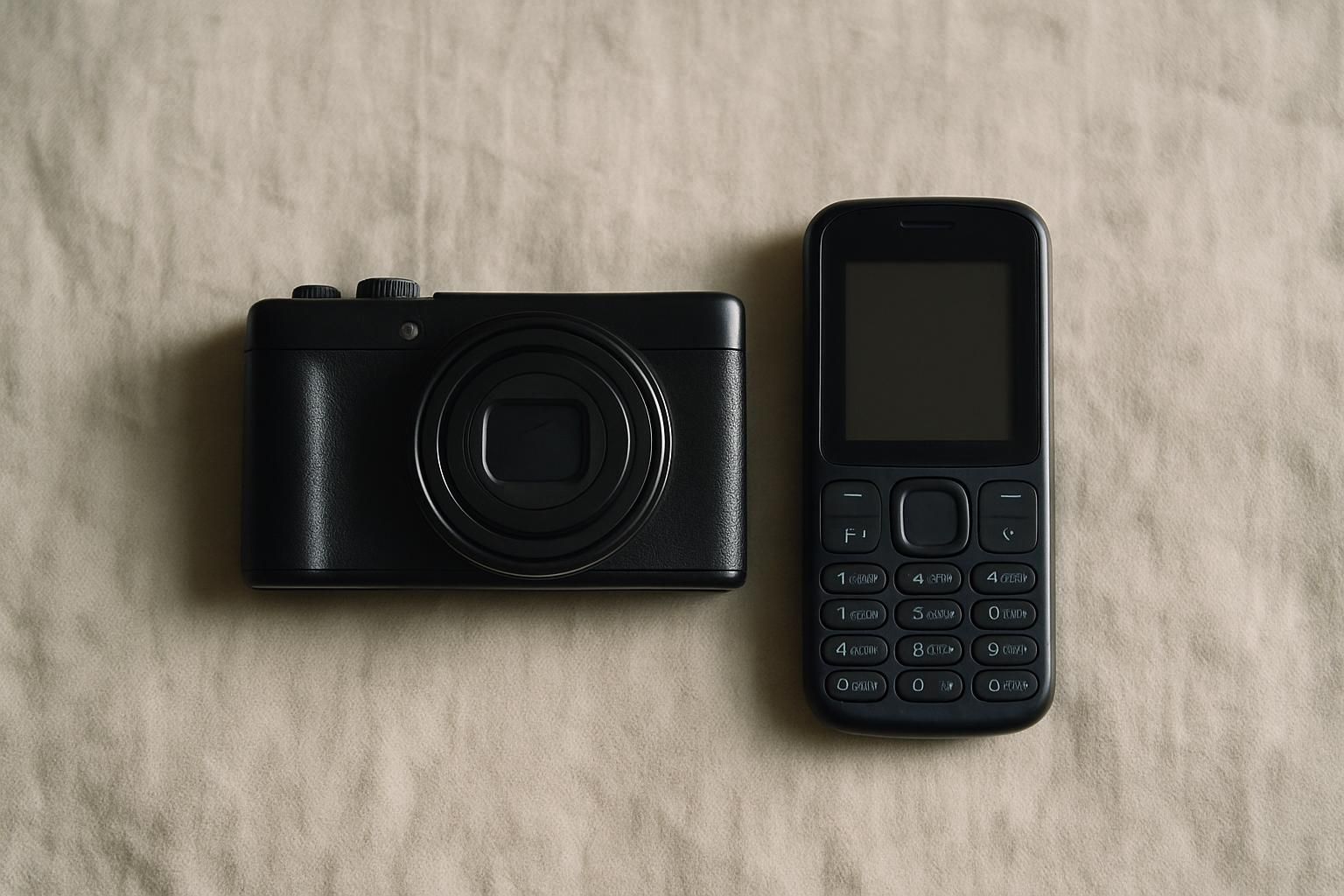
Search for a dumb phone with a good camera and you will find listings promising 2 megapixels as though it were a feature. It was, in 2007. The truth for most of the last decade is that basic phone cameras are decoration, present so the box has one more bullet point, and not usable for a photo you would keep. That finally changed in 2026, though not in the way most articles suggest.
Why basic phone cameras are so bad, and it is not the megapixels
The number on the box is the least useful thing about a camera. A 2 megapixel sensor from a feature phone and a 12 megapixel output from a modern phone differ in three ways that matter far more than pixel count.
- Sensor size. The physical area collecting light. A feature phone sensor is a fraction of a smartphone’s, so it gathers a fraction of the light, so anything indoors comes out noisy and smeared.
- Processing. Modern phone photos are computed, not captured: several frames are stacked and combined in a fraction of a second. A basic phone has neither the chip nor the software to do this, so it saves one raw frame and that is what you get.
- Focus. Most feature phone cameras are fixed focus. Nothing closer than about a metre will ever be sharp, which rules out most of what people photograph.
This is why a 2 megapixel keypad phone and a 12 megapixel smartphone are not two points on the same scale. They are different categories of object.
The one dumb phone with a real camera
The Light Phone III is the first phone that is genuinely minimal and has a camera you would choose to use. The maker specifies a 50 megapixel rear sensor with a 12 megapixel default output, an 8 megapixel front sensor, an optical stabiliser, autofocus and a flash. Those are ordinary mid range smartphone components, which is exactly the point: nobody had put them in a phone with no app store before.
The camera tool itself is deliberately plain. Three modes, photo, video and selfie, no filters, no editing, no album that scrolls forever. Set your expectations accordingly: this is a good sensor with very little computational photography behind it, so the files look flatter than what a current iPhone or Pixel hands you. That is the design rather than a fault, and whether it reads as honest or as disappointing depends on what you wanted.
It is sold directly by the maker rather than through retailers, and it costs several times what a keypad phone costs. If the camera is the reason you are looking, it is still the only device in this category that answers the question directly.
The cheaper way to better photographs
If it is the pictures you are after rather than the phone, a pocket compact such as the Kodak PIXPRO FZ55 outshoots the Light Phone III outdoors for a fraction of the money, because a 5x optical zoom and a 28 mm lens are physical things no sensor can substitute for. It pairs with any keypad phone you already own. The cost is two objects in your pockets instead of one; more on that further down.
If you want the best camera in the smallest phone
Drop the requirement that it be a dumb phone and the picture changes completely. A tiny Android is not a dumb phone, but it is small enough that most people stop using it like a smartphone, and the cameras are in a different league.
The Unihertz Jelly Max is specified by its maker with a 100 megapixel main camera, an 8 megapixel telephoto and a 32 megapixel front camera, in a five inch body. The Jelly Star is the more interesting one for this purpose: a three inch phone with a 48 megapixel rear and 8 megapixel front camera, small enough to disappear into a pocket. The Jelly 2E is the cheapest of the three and the weakest camera of the three; buy it for the size, not for the photos.
The catch is the obvious one. These run full Android with the Play Store, so nothing stops you reinstalling everything you left behind. The small screen does most of the work of keeping you off it, which is more than any app blocker manages, but the discipline is yours.
What the flip phone cameras actually are
Two flip phones on the US market have cameras worth mentioning, and both need their expectations set. The rugged Android flip sold as the Unifone S22 is a waterproof, drop rated clamshell running Android 11 with a 2.8 inch touchscreen. Its camera is fine for photographing a serial number, a parking bay or a document. It is not a camera you take on holiday.
The V3 Android flip is the cheaper version of the same idea: a classic clamshell with two screens running Android 11 Go, with Wi-Fi and GPS in the maker’s own listing. Same verdict on the camera. If you want a flip phone for the shape and the discipline, either is a reasonable buy; see our guide to flip phones that run WhatsApp for what else they can and cannot do.
Everything below that, and that includes almost every phone sold as a senior phone or an emergency phone, has a fixed focus sensor of 0.3 to 2 megapixels. The UNIWA V202T is a good example of the category: a genuinely simple 4G flip, and its camera exists to fill a line on the box.
The answer most people end up with
There is a version of this that costs less than any of the above and takes better photographs than all of them. Carry a plain keypad phone and a separate pocket camera.
A compact like the Kodak PIXPRO FZ55 has a 16 megapixel sensor and, more importantly, a real 5x optical zoom and a 28 mm wide angle lens, both of which are physical things a phone cannot fake. Point and shoot cameras have become popular again for exactly this reason: they do one job, they have no notifications, and taking a photo is a decision rather than a reflex. Any compact in this class will beat every phone on this page except the Light Phone III, and beat that one outdoors at any distance.
The cost is that you have to carry it and remember it, which is the same discipline the whole exercise is about. People who photograph rarely find this obvious; people who photograph constantly find it unbearable, which is worth knowing about yourself before you spend anything.
Side by side
| Option | Camera you get | Honest verdict |
|---|---|---|
| Light Phone III | 50 Mpx sensor, 12 Mpx output, stabiliser, autofocus | The only real camera on a minimal phone. Flat by design |
| Unihertz Jelly Star | 48 Mpx rear, 8 Mpx front, three inch screen | Best camera per cubic centimetre. Still a full Android |
| Unihertz Jelly Max | 100 Mpx main, 8 Mpx tele, 32 Mpx front | The best camera here, and the least dumb phone |
| Android flip (Unifone S22, V3) | Low resolution, fixed focus | Fine for documents and receipts, not for photographs |
| Keypad phone plus a compact camera | Real optics, optical zoom, no notifications | Cheapest, best pictures, two objects to carry |
In short
- Megapixels are the least useful number. Sensor size, processing and focus decide whether a photo is usable.
- The Light Phone III is the only genuinely minimal phone with proper camera hardware, and its output is deliberately unprocessed.
- For the best camera in the smallest device, a Unihertz Jelly is far ahead, at the cost of being a real Android phone.
- Flip phone cameras are for documents, not for photographs.
- A keypad phone plus a pocket compact costs less and takes better pictures than any dumb phone on the market.
Related guides
- Dumb phones that can navigate
- Dumb phones that can share a connection
- Dumb phones that run WhatsApp in 2026
- Flip phones that run WhatsApp in 2026
- Which basic phone suits a teenager best
Some links to Amazon are affiliate links: if you buy through them, we earn a small commission at no extra cost to you.